St. Brigid’s Day Coffee Morning at the Consulate General of Ireland, Vancouver
Last Friday, the Irish Women’s Network was delighted to host a wonderful St. Brigid’s Day coffee morning at the Consulate General of Ireland, Vancouver.
Over 40 guests joined for a morning of conversation, homemade baked goods and thoughtful reflections on inspirational women. The event captured the spirit of St. Brigid’s Day by celebrating creativity, resilience and community.
We extend our sincere thanks to Mary English-Cooper, Niamh Kelly, Ann Marie McGrath, Philomena Jordan and Susan Hayes Culleton for sharing personal stories about the women who have inspired them. Consul General Cathy Geagan also spoke about the women who inspire her, and her remarks are included below. Their stories, insights and contributions made this a memorable celebration of strong Irish women.
Our thanks also go to the volunteers who helped the morning run smoothly and to the talented bakers who provided delicious treats.
Finally, we are grateful to Deirdre Keohane and Brigid Festival Vancouver for permission to use Deirdre’s beautiful painting of Brigid in our event graphic.
We look forward to seeing you at future events!
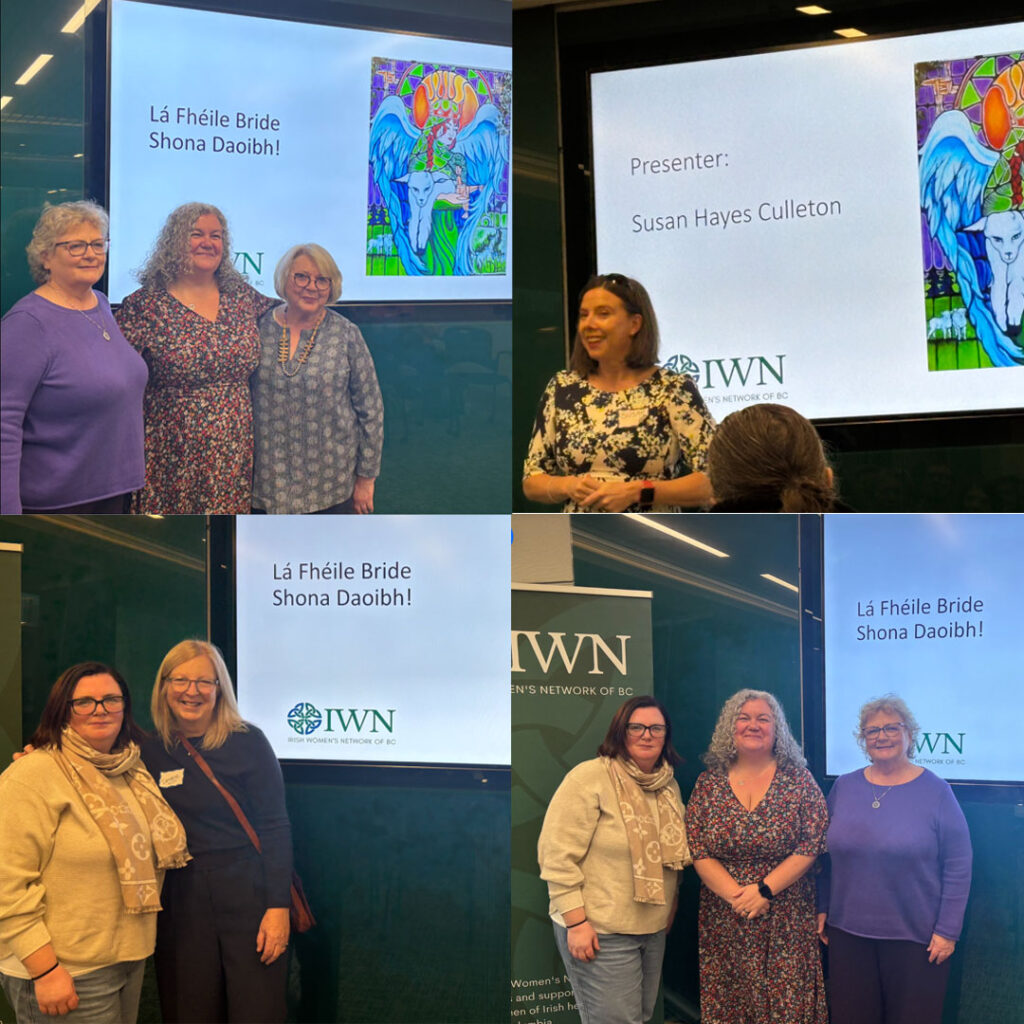
Photos:
Top left: Eilis Courtney, President, Irish Women’s Network; Consul General Cathy Geagan; Geraldine Megannety, Treasurer Irish Women’s Network
Top right: Susan Hayes Culleton
Bottom left: Sharon Woods, President, Irish Club of White Rock; Deirdre O’Ruairc, Irish Club of White Rock
Bottom right: Sharon Woods, President, Irish Club of White Rock; Consul General Cathy Geagan; Eilis Courtney, President, Irish Women’s Network.
____________
Remarks by Consul General Cathy Geagan.
Good morning, everyone, and welcome. It’s a joy to gather here today to celebrate St. Brigid’s Day, a time of renewal, light, and the promise of spring. That ‘renewal’ really resonates with me today, as I celebrate my fourth and final Brigid’s Day here in Vancouver, and in particular this IWN celebration that has become an annual highlight for so many.
Today, as we gather together, we celebrate something deeply meaningful: the legacy of Brigid, the significance of St. Brigid’s Day, and the power of women’s voices. Brigid is a figure who transcends time. As a goddess of ancient Ireland, she represented creativity, healing, and the hearth—a symbol of women’s vital role in nurturing life and community. As a saint, Brigid of Kildare became a leader, a protector, and a trailblazer for women. She built places where people could come together, find comfort, and create change—a reminder of the transformative power we hold when we lead with care and strength.
Half a century ago it was an accepted practice in Ireland that men were paid more than women for undertaking the same task and this was not illegal. Ireland has made enormous strides in gender equality over the past generation. But there is much more still to do. The Irish governments creation of a new public holiday in Brigid’s name in 2023 is part of a renewed focus on supporting and celebrating Irish women.
There is no shortage of Irish women to admire deeply, and sadly no shortage of Irish women who when not actively written out of history were certainly not part of the educational cannon. A personal favourite of mine is Margaret O’Carroll from Co Offaly, who died in 1451 – a medieval queen, patron of the arts, road and bridge builder that organised the 1440s equivalent of Electric Picnic: epic festivals of literature attended by 2,700 people, and described by scholars as “national events of high and singular importance”, earning her the title Margaret the Hospitable. A contemporary scholar noted that she “was the only woman that has made most of preparing highways, and erecting bridges, churches, and mass-books.”
Of course there’s pirate queen Gráinne Ní Mhaille, born in Co. Mayo in 1530 who cut off her beautiful long hair when her father wouldn’t let her come on a trading voyage to Spain, earning her the nickname or Gráinne Mhaol, or bald Gráinne. In addition to ruling the seas of the west coast of Ireland, she was fearless leader, canny diplomat, and long-time thorn in the side of the British ruling class. Lord president of Connacht Richard Bingham described her as “nurse to all rebellions in the province for this forty years”. Her influence was such that she was granted a meeting with Elizabeth I in 1593 during which, speaking in Latin, she secured the release of her son.
Rosie Hackett, who died in 1976, was just 18 when she organised a strike of 3,000 workers at Jacobs Biscuits, and co-founded the Irish Women Workers’ Union (IWWU) with Delia Larkin. During the 1913 Lockout, she was one of those who set up a soup kitchen. She was later active in the Rising, occupying Stephen’s Green alongside Constance Markievicz and others, and was one of the group responsible for printing off the 1916 Proclamation. She would later recall handing it to James Connolly, still dripping wet. She eventually gave 60 years to the trade union movement, and was one of the people responsible for carving out modern working conditions in Ireland. Rosie Hackett had a bridge in Dublin named in her honour in 2014.
If ever there was a story to offer a tantalising glimpse into what Irish women might have achieved throughout history had they been freed from expectations about gender, it’s the life of Margaret Ann Bulkley, a young Cork woman born in 1789, who grew up to hold the second highest medical office in the British Army. But she first had to reinvent herself as Dr James Barry. Bulkley became Barry at 20 at first as a route into university in Edinburgh, and possibly to escape the confines of life as a woman. It worked: Barry’s subsequent progress through the British Army was impressive. Everywhere she worked across the British empire, she brought about improvements to public health, sanitation and nutrition, and performed one of the first C-sections survived by both mother and child. Barry’s secret was revealed after her death aged 76, when her instructions that she be buried without an inspection of her body were ignored.
For all these exceptional women, there are countless thousands more whose great deeds are now great stories we should all know. But in 2023 when Eilis asked me to speak here on the woman I admired most I chose my mother – a woman who will not feature in any history booked and who through her eight children, 21 grandchildren, 11 great grandchildren and all those who have known and loved her has changed the world in a myriad ways. The women I admire most are my colleagues and my extraordinary friends. They are not women I learn about but women I know. I greatly admire the countless Irish women in our vast global diaspora who keep connections with their culture alive in their new homelands. I admire Eilis Courtney, who has contributed to the community in so many ways, and all the women who have kept the Irish Women’s Network of BC thriving for nearly thirty years.
But Brigid is an avatar for all women. It is women who have nurtured families, led revolutions, ignited movements, and transformed industries. The resilience, creativity, and vision of women touches every aspect of our lives.
So, let’s honour Brigid today by celebrating the strength, courage, and creativity that lives in each of us. Let us be the fire that lights the way for others and the voices that inspire change. Together, we are unstoppable.
Go raibh míle maith agaibh agus beannachti na Feile Bhríd
