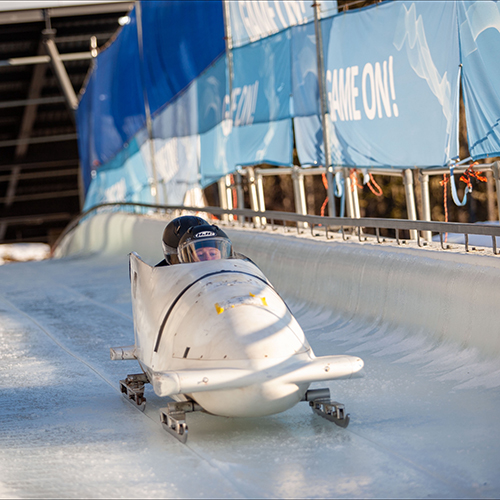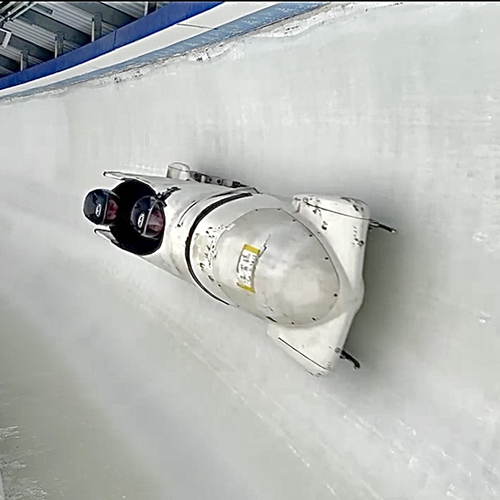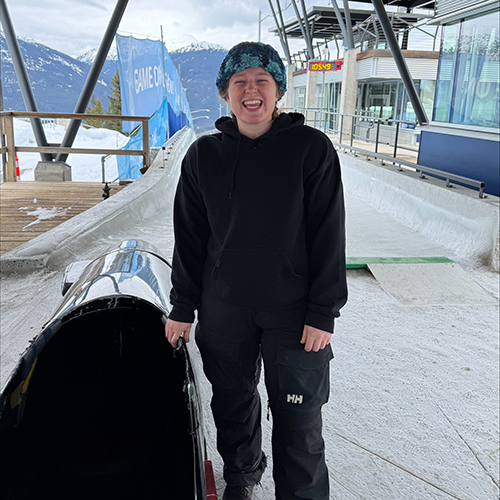

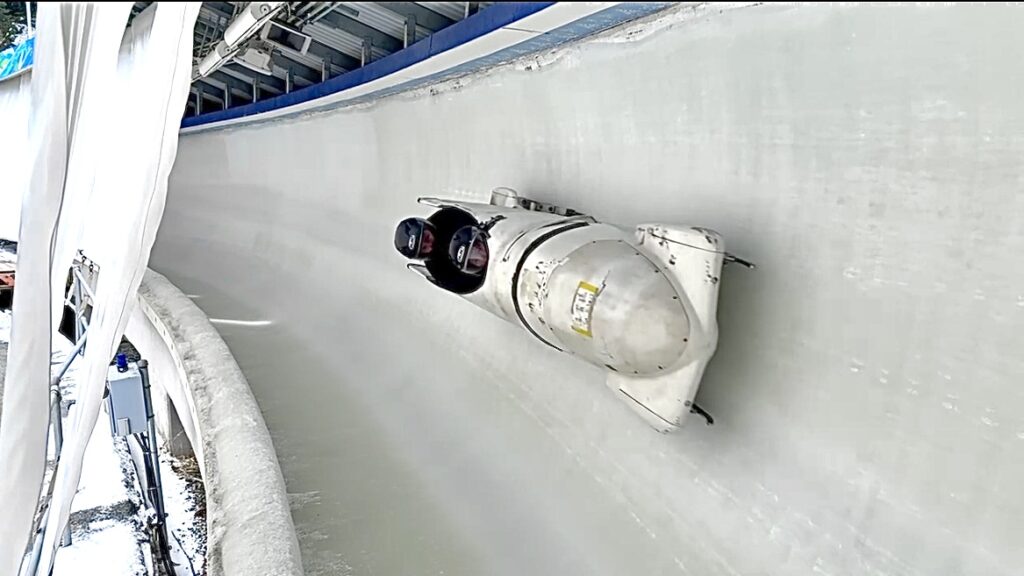
Freya McDowell spent months unable to put on a proper pair of shoes. Now she hurtles down an ice track at highway speed.
On December 5th and 6th, the Irish athlete will line up at the North American Cup in Whistler, British Columbia. It is the start of a season she once could not have imagined, and she is asking for help to get to the start line.
A Lake District childhood
Freya grew up in England’s Lake District with a Scottish mother and an Irish father from County Antrim. She started playing rugby at five and went on to play for Cumbria. She dreamed of ski holidays as a child, so the day she turned 18, she went and made it happen. She worked her first winter ski season, then did back-to-back seasons, teaching windsurfing and sailing in Greece and America through the summers. Whistler was the last resort on her list. “My plan was just to come here and do one final ski season,” she says. Two years later, she is still there.
The psoriatic arthritis diagnosis
Freya had always been physical, so what came next was a shock. Returning from America in 2023, she was hit by a sudden flare-up of psoriatic arthritis, an autoimmune disease. “All my joints, from my head to my toes, just puffed up,” she says. “I struggled just picking up a glass of water. I couldn’t wear proper shoes for six months.”
She had been away teaching watersports in America, and travelling Australia, only weeks earlier. Now she was housebound, getting through up to 16 pills a day and staring at a diagnosis that doctors described as lifelong. Support groups focused on managing daily life with the condition. “This is going to be my new life,” she remembers thinking. “And I cannot live like this.”
The mental toll was as heavy as the physical one. “It was a really big struggle, especially mentally, just being stuck in the house all day.”
Steroids and a strong course of medication changed the picture slowly. Freya could walk a little further, then a little further again. After seven months she came off the steroids and flew back to America to teach windsurfing. Today the disease is in remission. In May, she ran a half marathon. “I wouldn’t say I was ever a runner,” she admits. “But I wanted to prove to myself that my body was mine again.”
Still managing every day
Remission is not the same as a cure. Freya still lives with fatigue, and she has to read her body carefully. “If my knees are sore, I have to tell myself that’s because I’m exercising. But in the back of my head I’m thinking, I’m going to have a flare-up and not be able to move.” Retraining that thought is a daily discipline, she says, as is knowing when to push and when to rest.
It has also given her a new perspective. ““I don’t want an autoimmune disease to define what I can and can’t do. Instead of thinking, oh, I have to work out, it’s, I get to work out. I get to use my body.”
Her advice to anyone newly diagnosed is simple: “Believe in the meds. Rest. Give your body time to recover. It’s painful, and the meds will start to work, and you will get better.”
Falling into bobsleigh
Whistler’s housing crisis is notorious, so in 2024 Freya applied for any job that came with accommodation. One was a track worker role at the Whistler Sliding Centre. “I didn’t know anything about bobsleigh, but I applied,” she laughs.
The job meant helping with the public ride programme, in which a professional pilot takes passengers down from halfway. Pilots need training runs first, and staff were pulled in to ride in the back. Freya almost said no. She had seen elite athletes crash during national team training weeks, and her job at the finish line involves chasing runaway sleds with a hook to help the athletes out. She wondered, “How are these people walking after this?”
She got in anyway and fell in love. A Christmas present from one of her brothers, a week-long driving camp, taught her to pilot a proper bobsleigh. By the end of last winter she had over six weeks of training behind her on the fastest track in the world.
Learning has been brutal. The Whistler track has 16 corners, and beginners start from corner seven. They pick up serious speed with little room to control it. “The first few times, you’re absolutely smashing into the walls,” Freya says. “The bruises you get in your first week are insane. There’s nothing you can do except learn quicker.”
Racing for Ireland
Freya could have tried to race for Britain, but she chose Ireland, which has no bobsleigh team. Her father’s family still lives in Antrim, including her granny, her aunt and a bunch of second cousins, and she wants to feel closer to them. The Irish federation has entered her in the competition but there is no national funding. That makes the whole effort a DIY one. Freya finds and rents the sled, books her training camps, handles travel and registers for races, all while raising the money herself.
To qualify for a North American Cup, pilots must complete six out of eight successful runs in official training without crashing. After that, she needs only her country to sign her up. She will compete in the two-man bobsleigh in Whistler, training nearly every day in the run-up. Lake Placid in New York follows in January, and she hopes to make the trip to La Plagne in France, the Olympic venue. A European tour is the dream for next season.
Beyond her own results, Freya wants to grow the sport in Ireland. She notes that a lot of Irish people live in Vancouver and Squamish, and she hopes to draw some of them in, and maybe form a men’s team in the future or bring more women into sledding.
How you can help
Bobsleigh is expensive. Sled rental alone is $1,000 CAD a week, and every run down the track costs $85. Add race fees, speed suits, helmets, protective gear and travel, and the bills mount quickly for an athlete with no federation budget behind her.
If you’d like to help Freya, you can contribute to her GoFundMe, every contribution, large or small, gets her closer to the start line. She is also looking for company sponsors. Interested businesses can contact her directly.
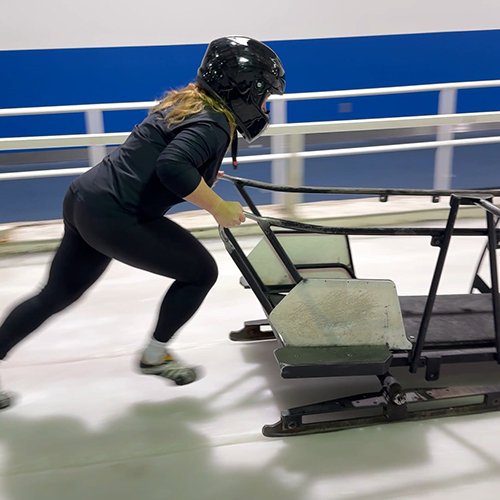
Supporters can also follow her on Instagram, and anyone curious about the sport can reach out there. “I’m always looking for people to get in the back of my sled,” she says. “I’m always happy for them to come up and have a go as a brakewoman.” The brakewoman pushes the sled at the start, then rides along until pulling the brakes at the finish. Those who catch the bug can sign up for the piloting courses.
If you’re near Whistler on December 5th and 6th, come down to the bobsleigh track for the North American Cup and show Freya some Irish support!